If you ask Dr. Abner Chou what prepared him to serve as president of The Master’s University, sooner or later he’ll mention, “The March.”
“I think The March was better than any training manual could have been,” he says.
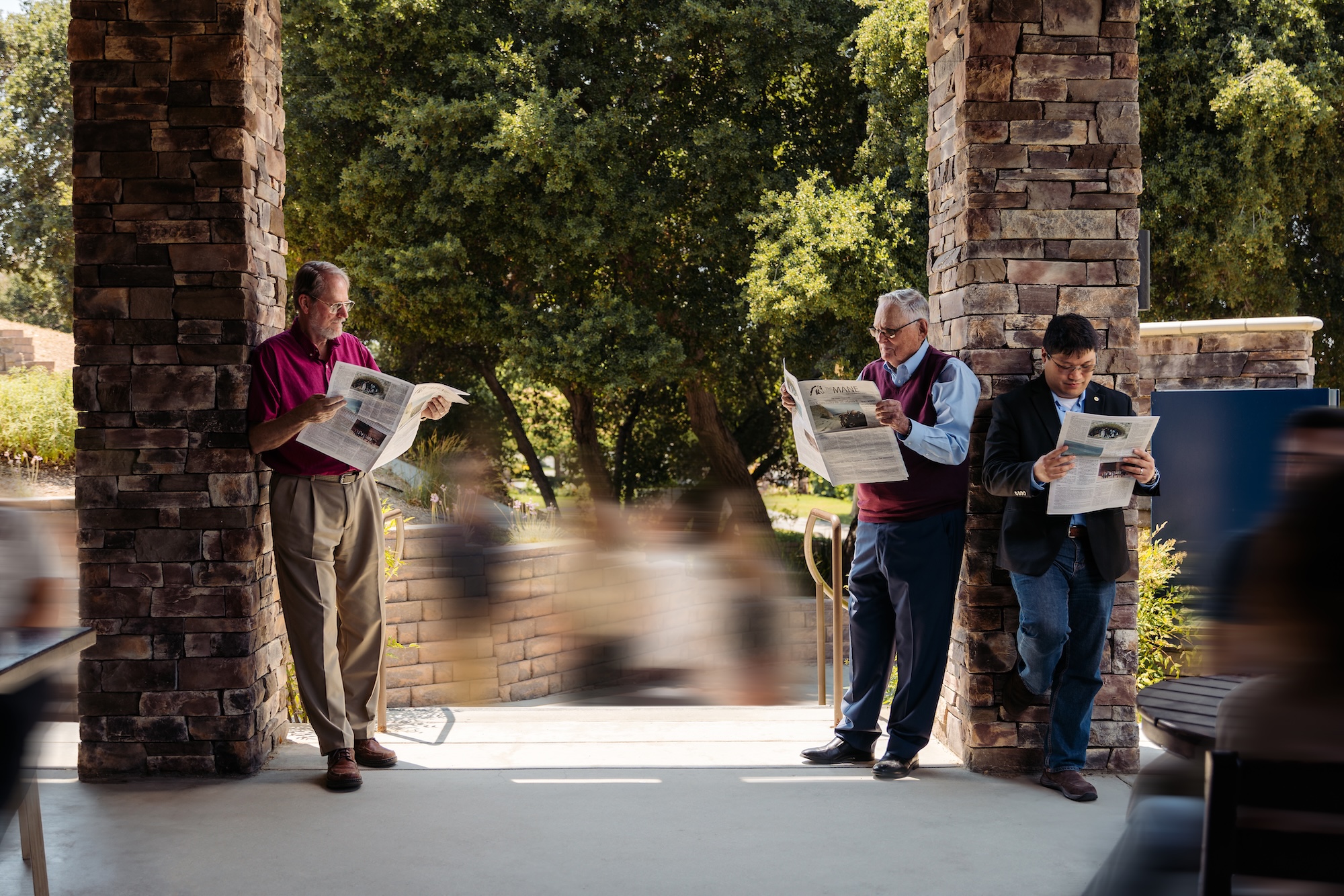
But The March isn’t a class or a global conference. It’s deceptively humble, and it can be found happening right on the sidewalk on campus most Friday mornings.
The March — one of TMU’s longest-standing traditions — brings professors together from across campus for coffee and wide-ranging conversation. Over the last 50 years it has grown not just into a context for friendships to form, but a venue where the history and heart of the University are passed down from one generation to the next.
Says Chou, “I think The March symbolizes the convictions, the camaraderie, and the commitment of the faculty to the Lord Jesus Christ. It’s also where those convictions are formed and preserved — and, hopefully, where they’re propelled into the future.”
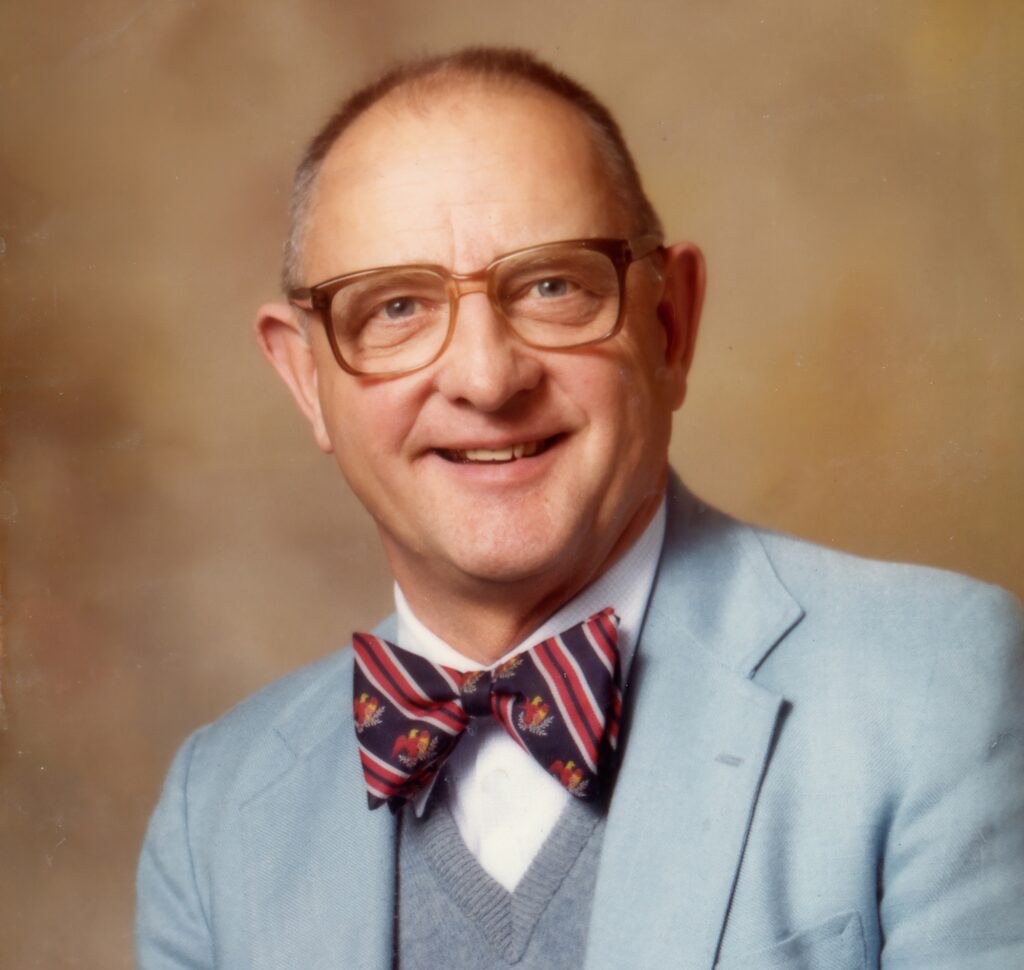
Prof. Russell Barney founded “The Chowder and Marching Society” at LABC in the 70s.
When Prof. Russell Barney arrived at Los Angeles Baptist College in the mid-70s, he carried with him an impressive force of personality. He’d flown combat missions in World War II, Korea, and Vietnam, and he brought a straight-laced military ethic to his work establishing LABC’s business program.
“All of his students had to wear ties,” says Dr. John Stead, TMU’s executive vice president, who was a young history professor at the time. “Barney was a classic military guy, and he was really tough in the classroom.”
But Barney also had a great sense of humor and — perhaps most pivotally for LABC — a vision to start something called “The Chowder and Marching Society” (named after an invite-only club for House Republicans).
“This Society claims to make a significant contribution toward the overall effectiveness of the College,” Barney wrote in a tongue-in-cheek 1977 advertisement for the group. “Discussions about what ought to be done are endless (however, consensus is seldom achieved); advice is freely given at any time, on any subject.”
In other words, his mission was to encourage professors to get together and chat — specifically, over coffee.
“A lot of the faculty had their offices in Vider back then,” Stead says. “So what Barney would do is walk out around 9 a.m. and blow this monstrous horn up and down the hall to call a march.”
At first, the destination was almost always The Way Station, a still-operational breakfast diner five minutes from campus. Stead remembers that the waitresses got to know the crew well and would joke around with them or join discussions. And true to Barney’s vision, the conversations were eclectic.
“Nothing was off the table,” Stead says. “It didn’t matter what you wanted to talk about — politics, athletics, theology, relationships, what you read in the paper that morning. We could get into some pretty good debates, and if you were looking at it from the outside, you’d think we were all crazy. But the main thing was always the fellowship, and we grew to really like and respect each other very highly.”
In those early days, Stead and business professor Dr. R.W. Mackey were among the regulars who took Barney up on his invitations. When Barney left LABC in the 1980s, Stead took over as de facto leader of the group — and when Dr. Gregg Frazer (now dean of the John P. Stead School of Humanities) came on faculty in 1988, he became a faithful participant. By then, the meetings had moved to a nearby coffee shop called Mitch’s Java ’n Jazz.
Though a number of professors joined in at some point, for many years The March centered around a handful of regulars who enjoyed debating a wide range of issues.
“There was a lot of humor and debating, but it really deepened our relationships,” Stead says. “Academic life tends to be very siloed. But here, we really do share the mission of the institution. In all of our discussion, that’s never debated. We’re all heavily involved in making sure that the mission comes first.”
Frazer agrees, saying that in his interactions with colleagues from other institutions, he has concluded the faculty culture at TMU is truly one of a kind.
“The primary reason, in my opinion, is because of our theological unity,” he says. “We don’t play games with that. We have real believers who are in tune with one another spiritually, and so that prevents a lot of the backbiting and squabbling that exists elsewhere.”
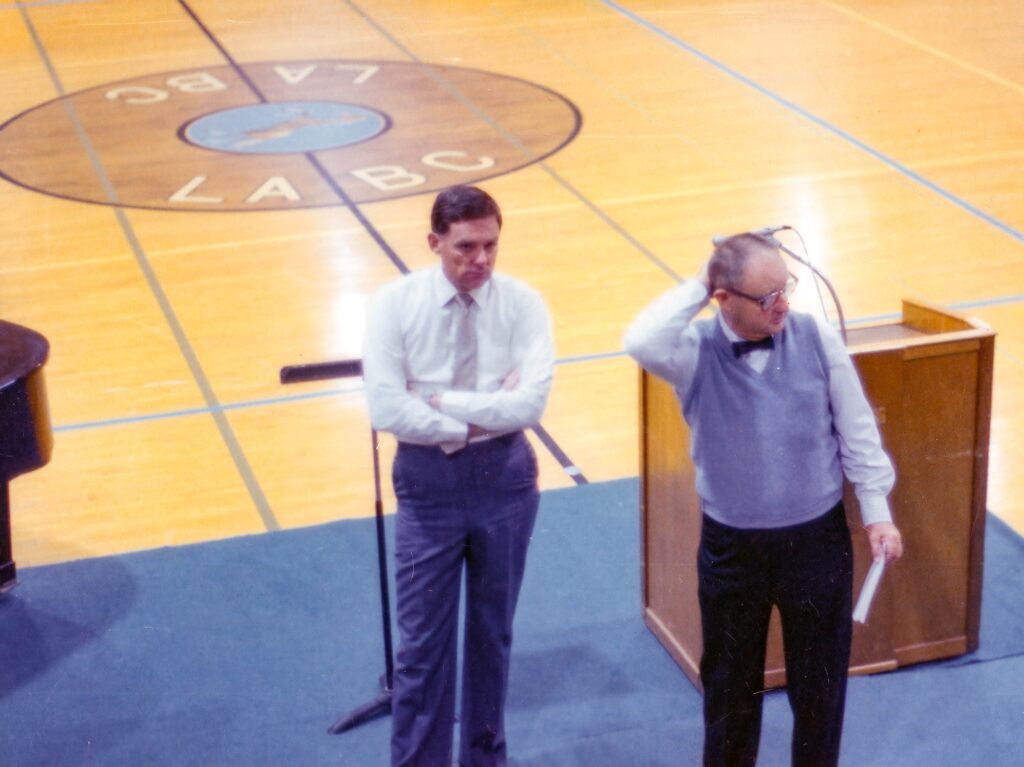
When Prof. Russell Barney (right) moved on from LABC, Dr. John Stead (left) became the de facto leader of The March.
In the midst of its friendship-building momentum, The March was also primed to exert a very different kind of influence at the school — by shaping a young Dr. Abner Chou during his early days as a professor.
In the 2000s, TMU hired several new faculty, some of whom attended The March on occasion. But none were more faithful than Chou.
“Dr. Stead and Dr. Frazer really went out of their way to bring me to The March,” Chou says. “And from that point forward, I was pretty much hooked.”
The March was now meeting at various Starbucks locations, and Chou sat and listened as Stead, Frazer, Dr. Thomas Halstead, and other long-time faculty members discussed theology and issues relating to the school — questions about direction, budget, administration, pedagogy, and everything else involved with running a college. He listened to them tell stories from prior eras of the school’s history, examples of challenges and examples of faithfulness.
In essence, he absorbed the best that The March could offer about where the school had been, what was going well and what the obstacles were, and what it could look like in the future.
“It opened my eyes to how to think through these issues,” Chou says. “It helped me understand where people were coming from, as well as learn from the mistakes of the past.”
And on top of all that, The March served as a living example of the camaraderie and conviction that had sustained the institution through its past hardships.
Chou remembers one Starbucks meeting during a particularly difficult season for the University. Outside it was pouring rain, and inside the mood was dour.
“The faculty were expressing concerns and commiserating,” Chou says, “but at the end we said, ‘Well, now we need to get back and press forward. No one’s giving up.’”
That shared moment over coffee helped them persevere. And Chou considers that story symbolic of a deeply rooted reality at TMU.
“It showed that we do stand for the truth, and that truth causes us to love each other deeply, and it causes us to love the cause of Christ,” Chou says. “That rare, exceptional camaraderie of The March — that resilience of unity — drives the entire institution forward.”
This camaraderie was perhaps never so clearly seen as in the early 2000s, when the group temporarily shifted to meeting at the home of Dr. C.W. Smith, a beloved Bible professor at TMU. Smith was then dying of cancer, and when he was no longer strong enough to go out to The March, The March came to him.
“It was a special time,” Frazer recalls. “We were able to enjoy those latter pieces of wisdom and fellowship from him. That time was an affirmation of the truths we already knew, from someone much closer to the reality of entering glory than we were at the time.”
In hindsight, Chou says that his time with The March proved to be “an immense training ground” for his responsibilities now as TMU’s president. This is because his goal as president isn’t to break from the past, but to build on TMU’s faithful legacy, which Dr. John MacArthur championed and defended during 40 years of leadership. Chou’s vision is to cultivate “more of the same, but even deeper and stronger and more thoughtful and more convictional.”
“I want to leverage every operation of the institution to accomplish that goal,” Chou says. “And The March gave me the information I need to do that.”
When professors started grabbing breakfast together back in the 70s, they likely never guessed how important their fledgling tradition would become.
“I’m so thankful for The March,” Chou says. “It seemed like something so small in the beginning, but now it’s turned into something that’s crucial to our institution’s fidelity.”
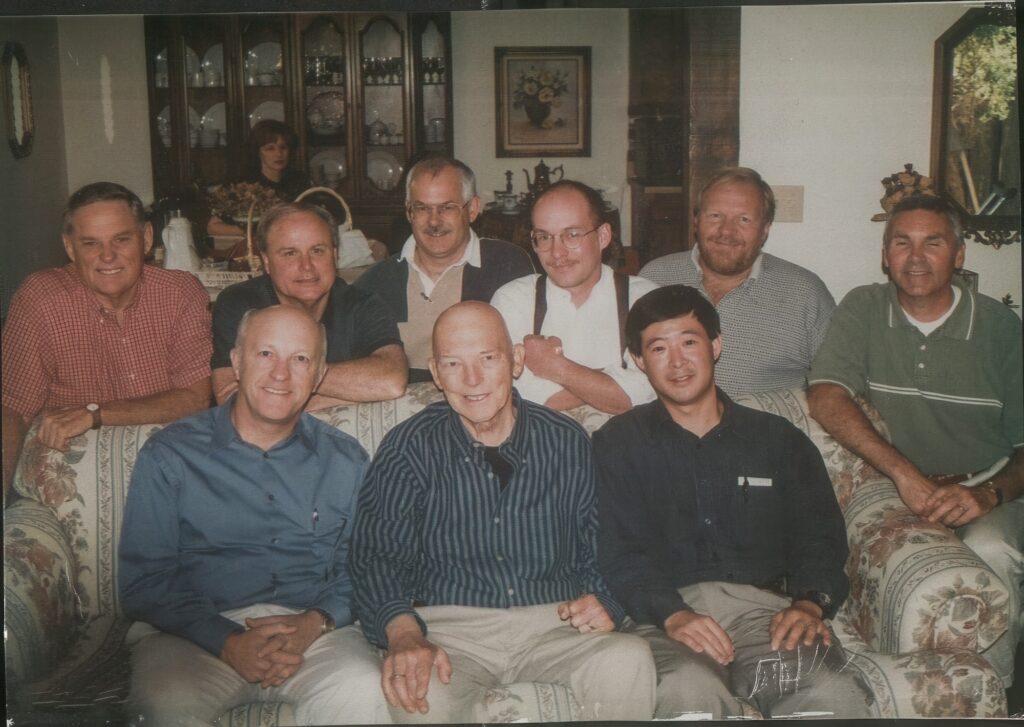
A meeting of The March at the home of Dr. C.W. Smith. Clockwise, starting in the top left: Dr. John Stead, Bill Oates, Dr. Greg Behle, Dr. Grant Horner, Randy Clark, Dr. R.W. Mackey, Dr. Saburo Matsumoto, Dr. C.W. Smith, and Dr. Will Varner.
Nowadays, The March can be found congregating on campus, meeting outside Trophy Coffee on most Friday mornings during chapel. As students worship just feet away inside The MacArthur Center, The March continues to do what it has always done: discuss anything and everything under the sun.
But now, its role in conveying institutional history is a deliberate feature rather than a happy side effect.
“The leadership wants to pass along the history of the school to newer faculty who don’t necessarily know where we’ve been and what we’ve gone through,” Frazer says, “how and why we have held firm down through the years, when almost everybody else has gone down.”
The groups are often bigger now, and a lot of the faces around the circle are faculty who have been at TMU less than five years. More than ever, The March has become a key place where new faculty internalize the mission and history of the school.
“That’s what it was for me when I was new,” Chou says, “and that’s what it needs to continue to be.”
At the same time, The March also remains one of the best places on campus to think through complicated questions and discover real answers.
Says Chou, “Stead used to say at The March, ‘We’re solving all the world’s problems.’ And he was tongue-in-cheek about it, but The March really did provide a lot of solutions. You had a lot of people gifted by the Lord who were bringing what the Lord had taught them, providentially, to bear on very tricky problems. And the fruit of it is what we’re seeing now.”
That fruit, fundamentally, is this: That from Chou’s role as president down to the newest faculty hire, everyone at TMU is laboring to honor Christ through serving the students faithfully, as all previous generations of TMU have longed and labored to do.
“We want this place to continue to be what the Lord has always wanted it to be,” Chou says. “His truth has never changed. It is revealed in the inerrant, inspired, authoritative Word of God. And we just want, in the end, that when we say, ‘This is The Master’s University and Seminary,’ that people would say, ‘Yes — it really is.”