
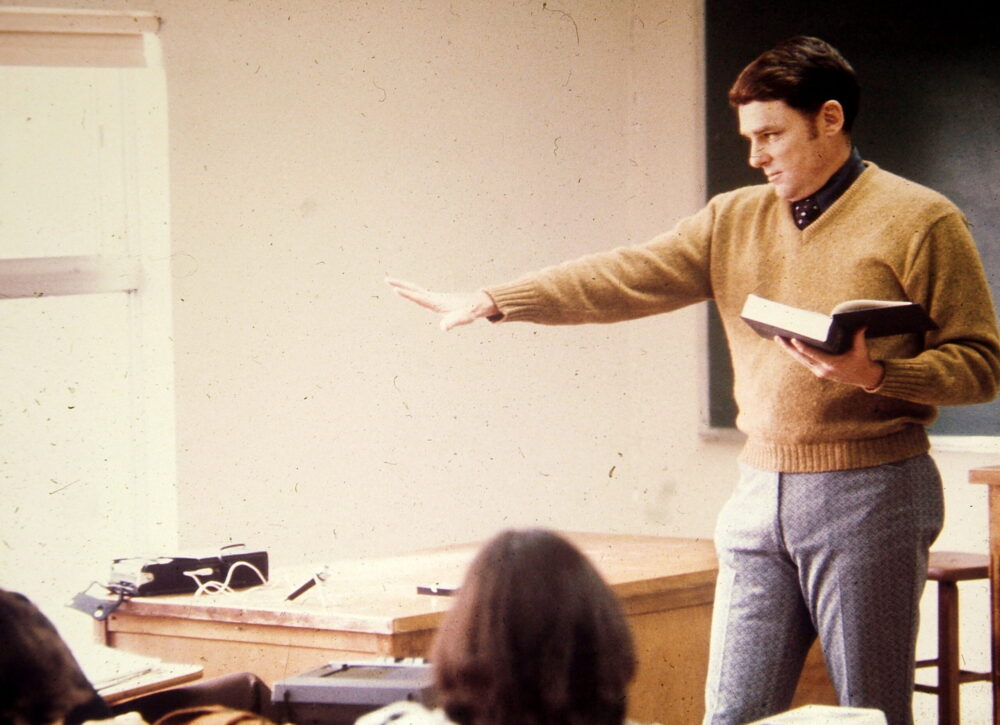
This photo was taken in 1982, early in Dr. John Stead’s second decade teaching at LABC.
Over the last 100 years, few people have shaped The Master’s University more fundamentally than Dr. John Stead.
He is the longest-serving member of the University’s faculty and staff, having been at TMU for more than 55 years. Over those decades, he has held positions at every level of the institution, from fresh-faced professor to interim president. He played an instrumental role in bringing Dr. John MacArthur to the school as president. He has taught generations of students and hired generations of faculty.
But more fundamentally than all of this, he has lived his life modeling what TMU is all about: grateful dependence on the Lord’s faithfulness and an enduring love for His people.
As Dr. John MacArthur once said, “No one is more synonymous with The Master’s University than John Stead.”
* * *
Born in 1940, John Stead’s education began around the dinner table. His father was self-educated, a veteran of both World Wars, and an avid follower of politics who ignited lively family discussions and kindled young John’s love of history.
He pursued that passion as he wound a circuitous route through college — first at Bob Jones University, then at Westmont College, and eventually at Cal State Los Angeles, where he changed majors from history to political science.
His undergrad education shaped him, but perhaps not as definitively as another aspect of his life in those years: his friendship with one Dr. John MacArthur. The two had met in high school and bonded over athletics. Come college, they both became involved in the college ministry at their home church in Burbank as leaders and speakers.
It was through this group that Stead discovered two life-altering loves. First, he developed a deep passion for teaching, coming to the realization that this is what he wanted to spend his life doing.
Second, he met a girl named Ellen Dunkin, whom he married in 1966. In so doing, he became the son-in-law of none other than Dr. John Dunkin, then president of Los Angeles Baptist College.
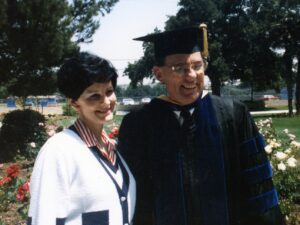
“In my mind, he really became my dad,” Stead says of Dr. Dunkin. “I could have no greater respect for him. He was so, so wise, and he taught me so many things about how to lead and make decisions.”
In the Lord’s providence, the foundation of the next 50-plus years of Stead’s life had fallen into place. He knew he wanted to become a professor — and, more than that, a professor at LABC. He went back to Cal State LA for his master’s degree and then joined LABC in 1970 as a professor of history.
His first teaching contract at LABC paid $6,000 a year. “We were incredibly poor,” Stead says. “We house-sat, and I worked for a man in my church on the night shift, cleaning lavatories and waxing floors for JCPenney.”
Still, Stead was confident that his work at LABC was the Lord’s will.
“It was just one answered prayer after another,” he says. “Every one of those steps from the time I went back to Cal State LA was the Lord opening doors. So I totally give Him credit.”
In 1978, after he finished his doctorate at the University of Southern California, several senior members of LABC’s faculty recommended Stead for the position of academic dean. Even though teaching was his first love, he accepted the new administrative role and continued to teach part time.
Though he was now spending less time in the classroom, in other ways he was now shaping every classroom on campus. Stead oversaw nearly every faculty hire between 1978 and 1995, bringing on TMU cornerstones such as Drs. Tom Halstead, Gregg Frazer, Greg Behle, Kurt Hild, and Clyde Greer.
“A lot of schools go down spiritually because they hire faculty who aren’t committed to the beliefs of the institution,” says Frazer, dean of the John P. Stead School of Humanities. “And then, eventually, when you get enough of those, they drag the school down with them.
“But Dr. Stead was always very careful to make sure his hires were solid and in line with our doctrinal statement — and, more than that, the spirit of TMU, which for the faculty is a collegiality and closeness.”
Beyond carefully hiring the right faculty, Stead also contributed to this spirit through his leadership over The March. Since the 1980s, Stead has been the unofficial ringleader of this fixture of TMU’s faculty culture, a tradition of coffee meetings where professors gather from across campus to share news, debate issues, and build friendships.
In this same period, Stead also had a hand in one of the greatest transitions the school has ever experienced. When his father-in-law retired from the presidency in 1985, LABC was in a fragile state. It needed a new leader with the strength and influence to carry the school’s mission forward.
Stead made a call to an old friend. He arranged to meet MacArthur for breakfast, where he asked if he might be interested in the presidency at LABC.
Ever since, the downstream effects of that conversation have been incalculable.
* * *
For all the positions Stead has held, and all the programs and lives he has influenced, one relationship may demonstrate his legacy best: his longtime friendship with Dr. Gregg Frazer.
Their story begins in 1974, with a Kansas City kid showing up for his first semester at LABC.
“I first met Dr. Stead on my first full day in California,” Frazer says. “I went down to the gym to see what pickup basketball game was going on. Some of the faculty were playing, and Dr. Stead was one of them.”
Afterwards, Stead invited Frazer and another student to join him at the Dodgers game that night.
“It was my first day in LA, and it ended with going to the Dodger game with Dr. Stead,” Frazer says.
Soon, Frazer was taking every class he could with his new mentor.
“My major became ‘Steadology,’” Frazer says. “That’s what I called it, because I had about 40 units with Dr. Stead. We became close, even when I was a student.”
When Frazer graduated, Stead gave him decisive advice on next steps. When Frazer got engaged, he asked Stead to officiate their wedding. When Stead decided that TMU needed a political studies program, he called Frazer and asked him to come start it.
“Most of the major events in my life, he’s been a part of it,” Frazer says. “We’ve been really close friends for more than 50 years. He’s been like a second father to me.”
This friendship has given Frazer a front-row seat to Stead’s influence at TMU.
“In my view, his biggest contribution has been stability,” Frazer says. “He’s always been Dr. Stead. You know, this is happening and that’s happening, but Dr. Stead is always steady and solid. He’s carrying on the history of the school.”
* * *
Since first arriving at LABC in 1970, Stead has watched the school go through presidential transitions, two name changes, and exponential growth. He has held an extensive list of administrative roles, including provost and senior vice president, interim president, and (currently) executive vice president.
“Through it all, he’s always been making sure — whatever position he’s in — that we’re staying true to the doctrinal statement and true to the mission of the school, as it’s always been,” Frazer says. “He’s been a lighthouse.”
So often, Stead has gone about accomplishing this in quiet, seemingly unremarkable ways: a phone call, a cup of coffee, or a conversation in the hall. Person by person, year by year, he has helped keep the school rooted in a mission that has remained fundamentally unchanged from 1927 to 1970 to 2026.
“I think what sums up Dr. Stead’s legacy is one word: people,” says Dr. Abner Chou, president of TMU.
“Dr. Stead has discipled faculty, he’s discipled staff, he’s discipled me and many others. And all of those conversations, all of that instruction, all of that dissemination of the truth — not just in fact, but in life lived — that is the legacy that endures onwards and steers this institution. That’s the legacy of Dr. Stead.”
Perhaps most crucially, Stead has remained and served all these years as a labor of love.
“I love the University all the way through,” Stead says. “It is precious to me, and being here has been such a blessing.”
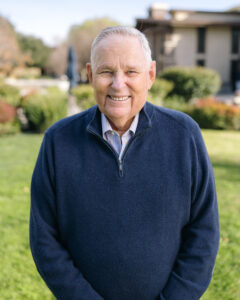
With everything that the school has experienced during Stead’s tenure, stability hasn’t always been easy to maintain. But ultimately, it hasn’t ever rested on him.
“We’ve had challenges here, and through it all we’ve really been dependent on the Lord,” Stead says. “What that creates is humility, as we’ve watched the Lord intervening time after time for us. And now as we look to the future, we say, ‘OK, Lord, this whole thing is your plan. We don’t really know what’s going to happen in the future. You have to open the door for us.’ And we just need to keep working hard and walking through it.”
This has been Stead’s perspective on his personal story, too, from discovering his love for teaching, to meeting his wife Ellen, to spending more than five decades at TMU.
“I look at my own life — my own life’s history,” Stead says, “and I really call it His story.”