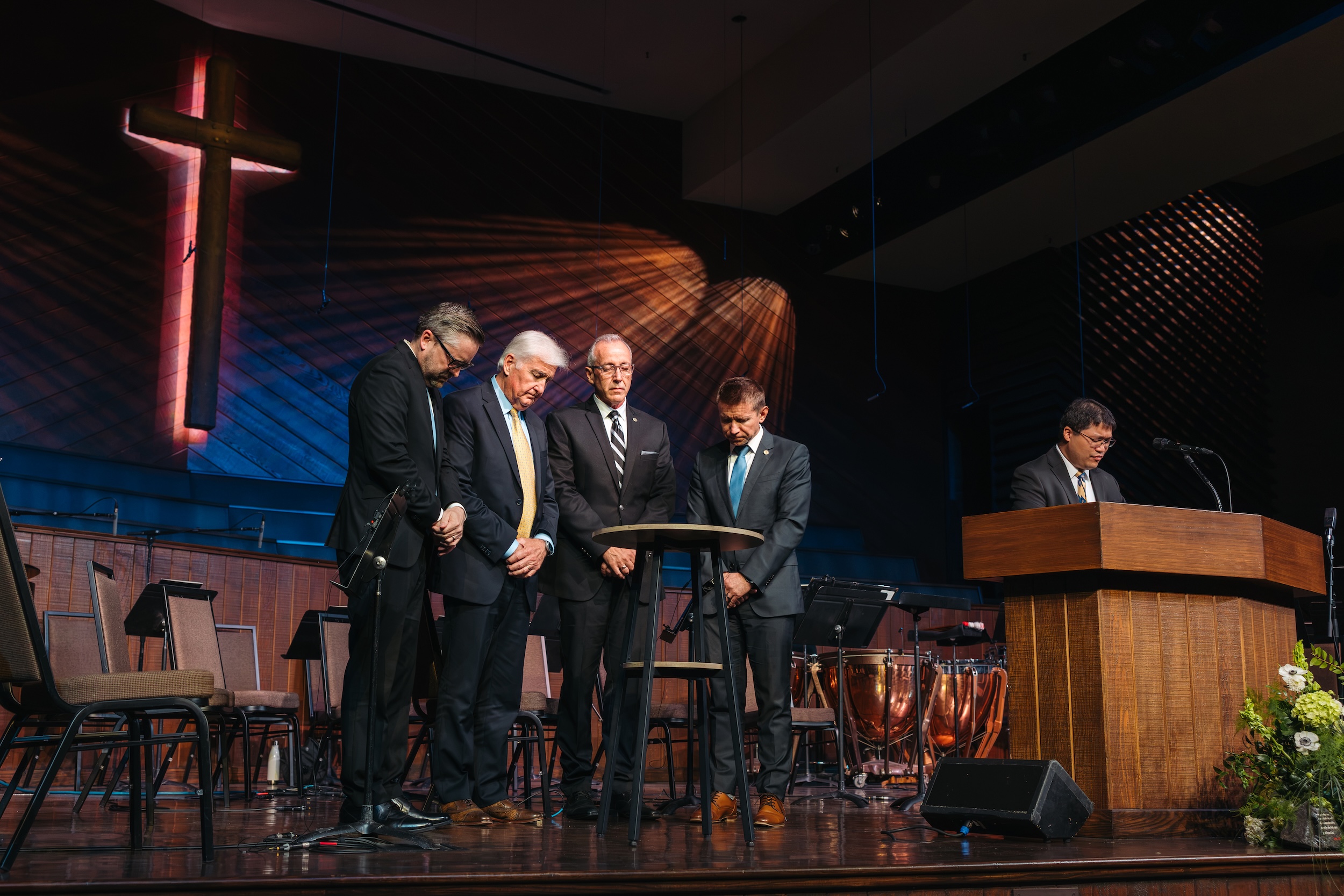
From left to right: Drs. Nathan Busenitz, Harry Walls, Mark Tatlock, Mark Zhakevich, and Abner Chou pray after formally ratifying the Statement on the Sufficiency of Scripture.
On Nov. 7, The Master’s University and Seminary (TMUS) officially ratified its Statement on the Sufficiency of Scripture during the closing session of a summit designed to articulate and defend this biblical doctrine.
Roughly 2,700 people participated in the Sufficiency of Scripture Summit at Grace Community Church in Sun Valley, Calif., on Nov. 6 and 7, with an additional 1,200 joining over livestream. This included 17 churches which hosted simulcast events.
Several ministries affiliated with TMUS partnered in writing and ratifying the statement, including The Master’s Academy International (TMAI), Grace to You (GTY), Grace Community Church (GCC), and The Master’s Fellowship (TMF).
Drs. Abner Chou (president of TMUS), H.B. Charles (dean at TMS), Nathan Busenitz (pastor-teacher at GCC), Mark Zhakevich (senior vice president at TMS), Mark Tatlock (president of TMAI), and Harry Walls (president of TMF) signed the statement as representatives of their respective ministries. All in-person and livestream attendees then had the opportunity to join them in signing the statement physically or digitally.
Chou says this statement is intended to be a document similar in scope and aim to the historic Chicago Statement on Biblical Inerrancy (signed in October 1978), arming the next generation of the church with clear language for carrying forward this essential doctrine with clarity and conviction.
The statement’s preamble highlights this goal, saying, “In light of the current battle for the Bible, we are putting forth this statement to both define and defend the doctrine of the sufficiency of Scripture. Scripture is authoritative revelation, and its scope, while not exhaustive, is comprehensive, framing all life and godliness. Neither common grace nor general revelation can ever place man’s observations on equal footing with what God has said.”
The statement is organized into five sections: the substance of Scripture, the scope of Scripture, the sufficiency of Scripture for godliness, the sufficiency of Scripture for life, and the sufficiency of Scripture for all things. Over the course of the summit, four keynote speakers (Chou, Charles, Walls, and Busenitz) unpacked each of those sections in turn, building to the statement’s concluding affirmation of Scripture’s sufficiency “for all things.”
The statement’s final affirmation reads in part, “We affirm that what Scripture directly addresses, it authoritatively defines, and to what it indirectly pertains, it definitively frames. We affirm that Scripture alone can guide every aspect of life to that which is eternally meaningful and the ultimate end of all existence, namely, the glory of God in Christ.”
This commitment to Scripture’s sufficiency, as held by the ministries represented at the summit, reflects the legacy of Dr. John MacArthur’s leadership and influence over these organizations. During a panel discussion before the summit’s first session on Nov. 6, Busenitz highlighted how Scripture’s sufficiency served as the foundation of MacArthur’s ministry.
“You could look at the scope of Pastor John’s ministry, and you could say, ‘Wow, look at these dozen or so ministries that are all part of the broader MacArthur family of ministries.’ But the reality is, from Pastor John’s perspective, he was just wanting to do one thing well — and that was, every Sunday, to preach the all-sufficient, authoritative, inspired Word of God accurately and clearly, and trust the Spirit of God to do the work.
“He did that over 56 years of ministry, and everything grew out of that. The Study Bible, the commentaries, the books, and the broadcasts are all an expression of Pastor John’s commitment to the one thing, which was the authority and sufficiency of Scripture.”
During this same discussion, Chou charged gathered ministry leaders to join in the fundamental goal of the statement and summit.
“There is a battle out there, and we need to make a stand,” he said. “And we need to make a stand together, because that is the way — in the providence of God — that we can continue to galvanize faithfulness for future generations.”
The summit website (statementonsufficiency.org) remains active, and it hosts all of the summit’s session recordings and the full text of the statement. The website also offers the ability for any visitor to add their signature digitally in affirmation of the statement.