
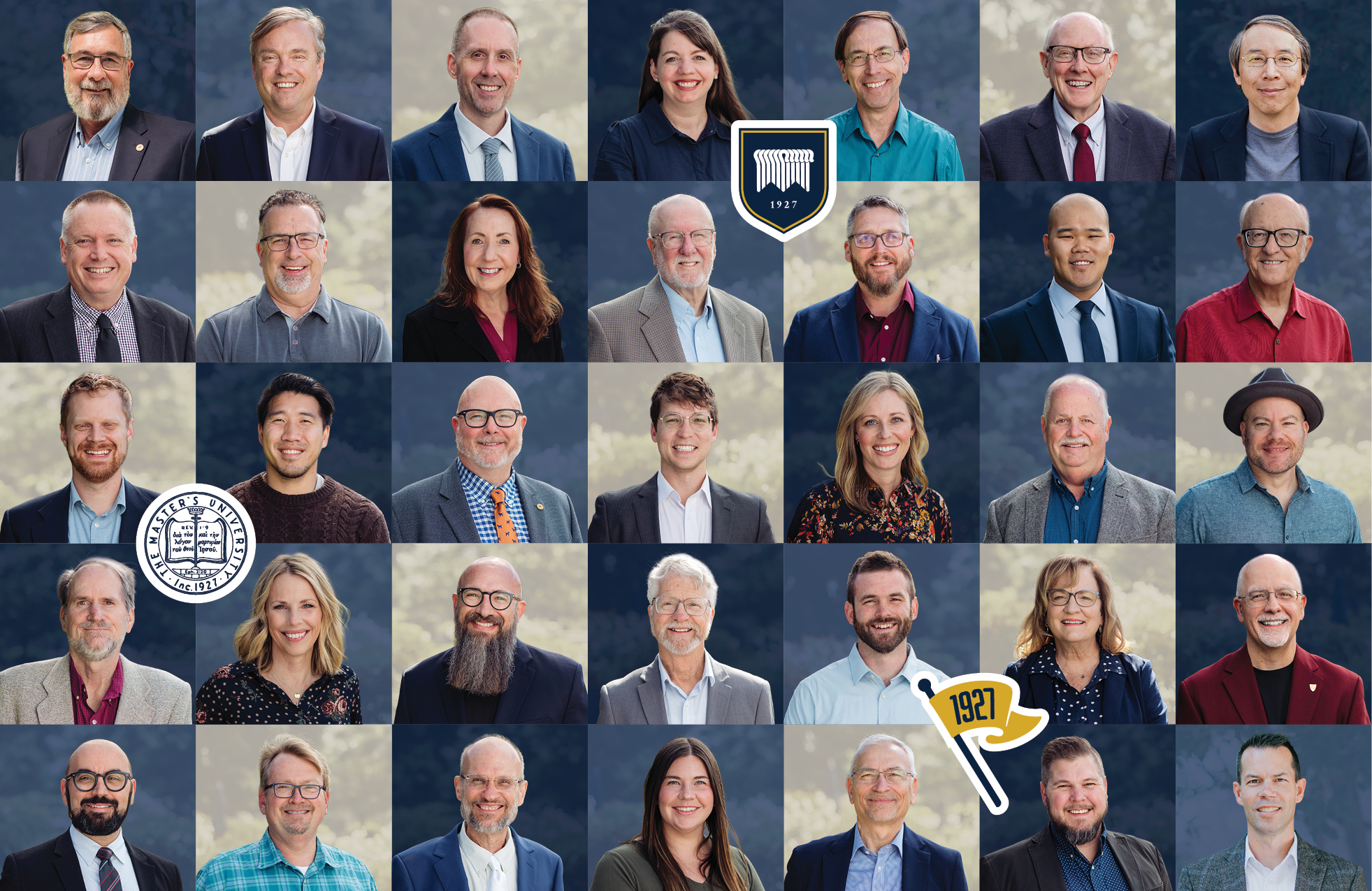
TMU’s commitment to Christ and Scripture starts with hiring faculty members who share that same heart.
In October of 2022, Dr. Marius Bahnean applied for an open faculty position at The Master’s University.
The job listing was for the school’s music department, so Bahnean was understandably confused when a Bible professor, Dr. Todd Bolen, reached out to schedule a doctrinal interview.
“I said, ‘Yes, but I didn’t apply for the School of Biblical Studies. I applied for music,’” Bahnean recalls. “Todd said, ‘No, no, this is the first step. This is how we do it here.’”
* * *
This story highlights the fact that, for almost 100 years, TMU has been dedicated to hiring a faculty united around love for Christ and a shared set of doctrinal convictions. Maintaining this common goal requires an extensive hiring process composed of several in-depth interviews, where the only candidates chosen are those who demonstrate excellence in their field, a strong ability to teach, and a deep commitment to Christ.
Dr. Mitch Hopewell, TMU’s provost and chief academic officer, explains the motivation behind this thorough process.
“How you hire and what kind of faculty you hire makes all the difference, because they live their doctrinal statement out every day in the classroom,” he says. “We tell our students we are committed to the Word of God — its inerrancy, sufficiency, and authority — and we back that up, because we only hire people who are going to affirm that.”
Dr. Todd Bolen, professor of Bible exposition, agrees.
“If anything defines a university, it’s their faculty,” says Bolen. “What the professors teach the students is who the students will be as graduates, representatives, and future professors.”
The hiring process begins once there is a vacancy within a department. From there, a search committee is formed, consisting of the department chair, the faculty of the department, a representative from the Bible department, and a faculty member from a separate department. This combination of people ensures, as Hopewell explains, “that we catch everything we can possibly catch about a person.”
After an applicant is selected, the committee starts the process with a doctrinal interview, which is performed by a member of TMU’s School of Biblical Studies.
As a trusted and longtime professor in the department, Bolen is often called upon to execute this doctrinal check.
“Todd started in Genesis, ended in Revelation, and asked me about everything in between,” says Bahnean, who is now in his third year at TMU. “It showed me that there are still academics who trust the Lord, are strong believers, and want to teach the next generation in the right way.”
During this interview, candidates are not permitted to bring any notes or even their Bibles with them, to ensure that their answers reflect what they truly believe and know about Scripture.
“It’s absolutely essential for all of our potential hires to explain to us what their convictions are and what their theology is,” Bolen says. “We want to know not just that they memorized the doctrinal statement, but that this is actually their identity — this is who they are. We don’t want to hire professors who don’t know the Bible like their students know the Bible.”
After the candidate has passed their doctrinal review, they can move forward to the next stage, which is an interview with the full search committee.
Says Bolen, “It is nice for me to know I’m one part of a unified team, all working to the same objective, and together we are going to accomplish the goal of hiring the best men and women to be the professors training the next generation.”
During this stage, the committee is trying to get to know the candidate and see how they would fit within their specific department.
If the committee approves, the candidate will be invited to visit campus in order to tour the school, teach a class, and sit for a final round of interviews with Hopewell and TMU president Dr. Abner Chou.
“Nothing’s done until those guys sign off,” says Bolen.
As provost, Hopewell looks at potential faculty members to determine whether they fit the larger culture at TMU by analyzing them through “four C’s”: convictions, compatibility, Curriculum Vitae (i.e. their comprehensive academic resume), and capability.
“When we’re looking for a cultural fit for faculty members, we’re looking for somebody who’s going to settle in and fit with the faculty really well,” says Hopewell. “If you go sit at lunch in the cafeteria, you’re going to see a table with a faculty member from pretty much every department on campus. That is very rare at universities. This faculty, they love and trust each other, and that makes the hiring process for culture that much more important.”
Having experienced all of these steps firsthand, Bahnean is grateful for the unity this process creates.
“Of course, as faculty, we are all different in the way we approach things,” he says. “But our goal is always going to be the same: put everything under the authority of the Word of Christ. That’s really unifying, because you know where to start and you know where to finish.”
The final step is an interview with Chou, who finishes the process by evaluating the candidate as a whole, focusing on their convictions and competence.
“I want to see how they are as a worshiper of Christ, and how they will disciple students toward that,” says Chou. “The paradigm for our faculty is to be a master of their discipline and a master of discipleship. That’s how I frame it, and the questions I’m asking them are meant to bring out whether they have that profile.”
Ultimately, the goal behind this hiring process is to ensure that TMU remains steadfast in its convictions by hiring faculty who are equally committed to those convictions.
“Some would say, ‘You guys are too serious for an undergraduate school,’” Bolen says. “But in another hundred years, we want to be who we are right now, and the most important way to do that is by hiring professors who are committed to what we believe.”
Hopewell agrees wholeheartedly.
“The legacy and faithfulness of faculty is worth so much more than credentials, or what we might find on paper,” he says. “We want those things, we want excellent people in their discipline, but above all we want doctrinal commitment and the ability to teach our students.”
This relates to a question Hopewell often receives, one with important implications as the University prepares to celebrate its Centennial in a matter of months: How can he be sure TMU won’t drift?
“My answer is that I can’t say for sure, because I don’t know the future. But the number one thing we do to try and make sure that never happens is hire the right faculty.”
Master’s Connect is the alumni platform for graduates of LABC, TMC, and TMU. Meet other alumni, receive mentorship, view job listings, and more.


The Master’s University and Seminary admit students of any race, color, national and ethnic origin to all the rights, privileges, programs, and activities generally accorded or made available to students at the school. It does not discriminate on the basis of race, color, national and ethnic origin in the administration of its educational policies, admissions policies, scholarship and loan programs, and athletic and other school-administered programs.
© 2026 The Master’s University Privacy Policy Copyright Info


| Cookie | Duration | Description |
|---|---|---|
| cookielawinfo-checkbox-analytics | 11 months | This cookie is set by GDPR Cookie Consent plugin. The cookie is used to store the user consent for the cookies in the category "Analytics". |
| cookielawinfo-checkbox-functional | 11 months | The cookie is set by GDPR cookie consent to record the user consent for the cookies in the category "Functional". |
| cookielawinfo-checkbox-necessary | 11 months | This cookie is set by GDPR Cookie Consent plugin. The cookies is used to store the user consent for the cookies in the category "Necessary". |
| cookielawinfo-checkbox-others | 11 months | This cookie is set by GDPR Cookie Consent plugin. The cookie is used to store the user consent for the cookies in the category "Other. |
| cookielawinfo-checkbox-performance | 11 months | This cookie is set by GDPR Cookie Consent plugin. The cookie is used to store the user consent for the cookies in the category "Performance". |
| viewed_cookie_policy | 11 months | The cookie is set by the GDPR Cookie Consent plugin and is used to store whether or not user has consented to the use of cookies. It does not store any personal data. |